

Jump to GB9WHP William Henry Preece Details of Station and Logbook.
Once a year, members of the Quantum Technology Club make the trip north to the Ruskin Museum in Coniston. The museum is famous for housing Bluebird K7, the boat in which Donald Campbell tragically lost his life whilst try to break the Water World Speed Record in 1967.
Very kindly, the museum lets the club use their outdoor display space, behind the main building, to run a special event station to celebrate the wireless communications experiments of William Henry Preece across Coniston Water
William Henry Preece
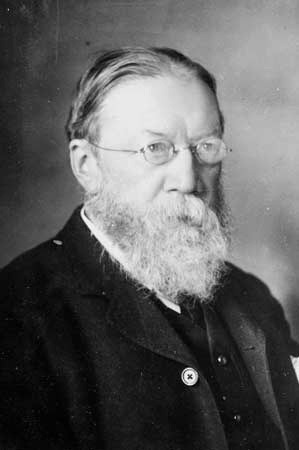
I won’t go into too much detail here about William Henry Preece here as there is a more detailed article on the Quantum website. However, he was born in Caernarfon in 1834, William Henry Preece and eventually became the Chief Engineer to the Post Office. After his own experiments were concluded he went on to support Marconi’s experiments and bringing it to fruition as a workable commercial proposition.
Preece’s experiments into wireless communications
Preece’s became aware that an electric signal sent down one wire could be picked up on another parallel wire some distance apart in 1884. That initial distance was about 80′, about 25m, and the wires were telephone cables. This presented him with a security problem. Today, we refer to this phenomena as as inductive crosstalk. However, whilst this was a problem to be resolved on telephone networks, Preece did see wider benefits to inductive communications over longer distances.
1885 saw Preece conduct experiments using inductive communications in Newcastle. With a colleague, he successfully extended his method of wireless communication to over a quarter of a mile reliably. There were also feint receptions of his signals up to ten miles away.
In 1886 this distance for reliable wireless communication had been increased further to over 40 miles and in 1887 experiments began over bodies of water. In 1889 he successfully communicated across the Menai Straights in Wales, and then over Coniston Water, a distance of about 1 mile. About five years before Marconi’s successful transmission of wireless signals between Flat Holm Island (Bristol Channel) and Lavernock Point (South of Cardiff), Preece achieved the same feat over a distance of 4 miles.
Eventually, Preece came to the conclusion that whilst his experiments had been successful, inductive communication was impractical – the length of the antennae required was proportional to the distances to be reached and the equipment required was cumbersome and expensive. It did have limited commercial success, being pressed into service when the cable connecting the Isle of Mull and Oban broke, for example. However, radio would have proven a better alternative had it been available at the time.
Marconi
Having met with Marconi in 1896, Preece was impressed with what he observed. For the next three years he supported the young Italian providing him with resources he required to help him improve his equipment. Preece also arranged demonstrations and helped him obtain finances to found his business.
Details of the GB9WHP William Henry Preece special event station
Callsign used
GB9WHP
Date
29h August, 2026
Weather conditions
Overcast, threatening rain (that never came), 18/19 degrees with little to no breeze.
Equipment used
Icom IC-705, mAT-705 Antenna Tuner, EcoFlow RIVER 2 power station, Icom LC-192 back pack, cheap Chinese 5.6M/18.3 FT QRP Antenna, Pota-Flex 7 coaxial feeder cable, and 14″ Lenovo IdeaPad Flex 5 Core i7 with 16GB.
Software used
HAMRS Pro logbook, WSJT-X 3.0.1 64-bit datamodes software, BktTimeSync for time synchronisation, Microsoft Windows 11 and HamDeck Grid Distance Calculator.
Bands, modes and power used
40, 30, 20m, 17m, and 15m using 5w of FT8.
Station setup
The back of the van was the base for this station. The cheap Chinese antenna was located as far away from the van as possible and connected to the transceiver using my favourite Pota-Flex 7 cable. The station operated at 5w and was powered by EcoFlow power stations.
Notable contacts
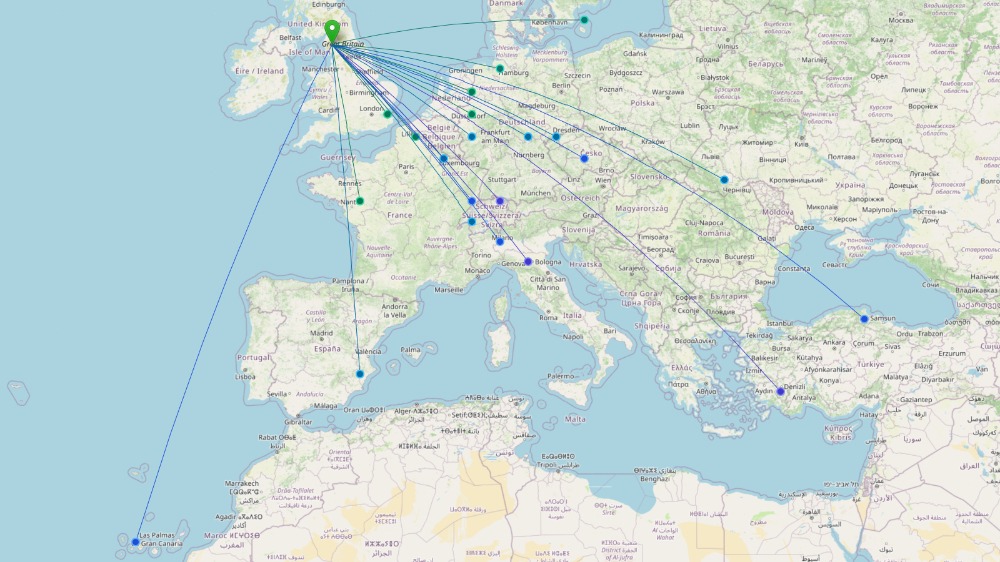
Three continents were worked; Africa, Europe and Asia. None was particularly ground-breaking, distance-wise, but given the location and low power I was more than pleased with this.
How did the GB9WHP William Henry Preece special event station go?
Normally the special event station would be accompanied by a technology display of projects that the club has completed in recent years. Last year, the weather forecast was pretty dire, so the whole event was called off. This year, the weather forecast was, again, not very kind. However, we have the camper van this year so it was decided that the special event station would proceed from inside the van, but that the technology display would not happen as we didn’t want to be carry wet tents around all weekend.


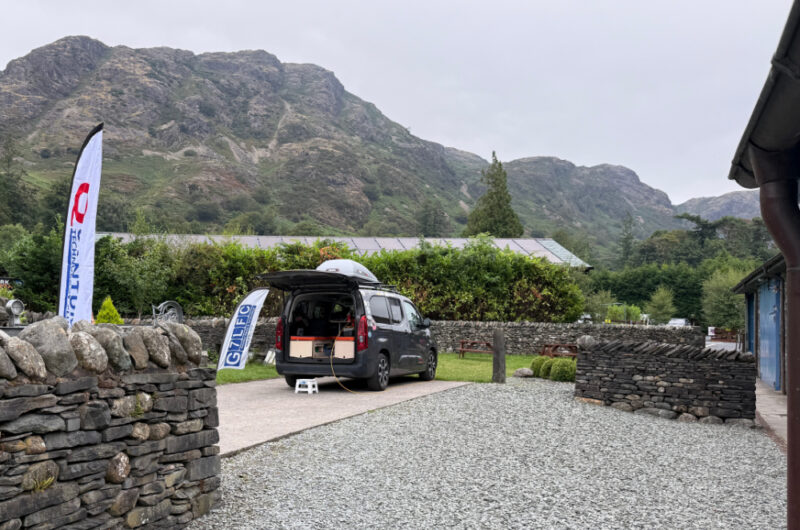
As a result Ali, my long-suffering wife, went off to explore the World of Beatrix Potter and her home at Hill Top, whilst I set up at the museum. I was surprised to find out that there was a new footpath running behind the main building this year, connecting the new Bluebird Car Park with the museum. And very popular it was proving to be too. As a result we had no means of getting the power cable from the building to the van safely, so it was decided to operate using my usual set up; low power from a power station.

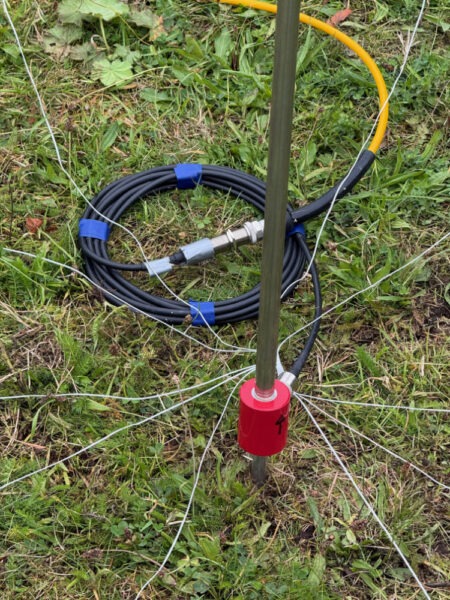
Unfortunately, I was experiencing RF breakthrough on all bands when using single-band Ampro antennas on the roof of the van. I had found this to be an issue of a single band before, but never on all bands. Fortunately, I had my cheap £20 Chinese telescopic antenna with me, so it was pressed into service about 15m away from the van, connected to the radio using some good quality M&P Pota-Flex 7. This cable has a low enough loss for HF work and is designed to be easy to see and tough – certainly tough enough to walk on without it getting damaged.
Given that the Old Man of Coniston (803m) was located to the west of us, and Weatherlam (745m) to our north west, it was accepted that most, if not all contacts were going to be made to the east of us. And this panned out with the exception of a decent contact down to the Canary Isles, off the coast of Africa.
Together with the location having high mountains close by, propagation conditions were very favourable – there had been lots of solar activity over the previous couple of days and into the Saturday. There was an ongoing G2 (Moderate) geomagnetic storm and there had been a succession of coronal mass ejections (CMEs) and a coronal hole high-speed stream impacting Earth’s magnetic field. The result was depressed maximum useable frequencies (MUFs) and this was evidenced by the fact that no contacts were made on 12m, or 10m – there was nothing to be heard even using FT8.
As a result, over a period of nearly four hours, just twenty-nine contacts were made – that’s about one contact every nine minutes, or so. For sure, my normal special event antenna (SRC HF-360 vertical) and higher power Yaesu FT-991 were not used for this station, but I’m not convinced they’d have made too much difference this time out.
Many thanks go to the Ruskin Museum for their support.
GB9WHP William Henry Preece Special Event Station Map & Logbook
| Callsign | Date | Time | Band | Mode | RST Tx | RST Rx | Locator | Power |
|---|---|---|---|---|---|---|---|---|
| EC5M | 20260829 | 100730 | 20m | FT8 | +03 | +00 | IM98 | 5 |
| DK6WS | 20260829 | 101115 | 20m | FT8 | -08 | -18 | JO30 | 5 |
| EC5M | 20260829 | 103900 | 15m | FT8 | -07 | -19 | IM98 | 5 |
| DK6WH | 20260829 | 104315 | 20m | FT8 | -04 | -10 | JO50 | 5 |
| DL5MKR | 20260829 | 105400 | 20m | FT8 | -05 | -21 | JO60 | 5 |
| F4DIA | 20260829 | 110000 | 20m | FT8 | +01 | -10 | JN36 | 5 |
| TA6MMI | 20260829 | 110530 | 17m | FT8 | -07 | -09 | KN71 | 5 |
| OK2CNI | 20260829 | 110800 | 17m | FT8 | +20 | -10 | JN79 | 5 |
| EA8UP | 20260829 | 114400 | 17m | FT8 | -01 | -19 | IL18 | 5 |
| I1RJP | 20260829 | 114600 | 17m | FT8 | -10 | -10 | JN45 | 5 |
| HB9SFL | 20260829 | 114730 | 17m | FT8 | -04 | -11 | JN37 | 5 |
| HB9INV | 20260829 | 115200 | 15m | FT8 | +00 | -14 | JN37 | 5 |
| HB9MVV | 20260829 | 115445 | 15m | FT8 | +00 | -12 | JN47 | 5 |
| HB3YDV | 20260829 | 121900 | 15m | FT8 | +04 | -09 | JN37 | 5 |
| HB9IOB | 20260829 | 122800 | 15m | FT8 | -03 | -09 | JN36 | 5 |
| IK4LZH | 20260829 | 123424 | 15m | FT8 | +14 | -24 | JN54 | 5 |
| PE1NAO | 20260829 | 124330 | 40m | FT8 | -09 | -21 | JO32 | 5 |
| F4SNF | 20260829 | 124545 | 40m | FT8 | -05 | -18 | IN97 | 5 |
| DL5WP | 20260829 | 130500 | 30m | FT8 | -04 | -13 | JO43 | 5 |
| OS4K | 20260829 | 130730 | 30m | FT8 | -13 | -12 | 5 | |
| G4DBW | 20260829 | 131845 | 40m | FT8 | -01 | -18 | JO01 | 5 |
| LX7I | 20260829 | 133000 | 20m | FT8 | +18 | +08 | JN29 | 5 |
| HB9ACA | 20260829 | 133600 | 20m | FT8 | +09 | -06 | JN36 | 5 |
| US2YW | 20260829 | 133700 | 20m | FT8 | +06 | -11 | KN28 | 5 |
| DK1TS | 20260829 | 135145 | 40m | FT8 | +07 | -16 | JO31 | 5 |
| F4FHM/QRP | 20260829 | 135330 | 40m | FT8 | -06 | -21 | 5 | |
| OZ9FF | 20260829 | 140015 | 30m | FT8 | -10 | -19 | JO75 | 5 |
| TA4DX | 20260829 | 142215 | 15m | FT8 | +09 | -15 | KM47 | 5 |
| F1LPT/P | 20260829 | 144030 | 40m | FT8 | +07 | -20 | JO10 | 5 |