
Jump to GB-0668 Goonhilly Downs Nature Reserve Details of Activation and Logbook.
This was my fourth activation of a historic communication site in Cornwall during my annual holiday – each one of them conveniently located in an official Parks on the Air (POTA) or UK Bunkers on the Air (UKBOTA) location:
- 09/08/2026 – GB-0264 Lizard Wireless Station
- 10/08/2026 – GB-0264 Wireless Point
- 13/08/2026 – GB-5932 Marconi Monument, Grounds and Centre at Poldhu
- 13/08/2026 – GB-0668 Goonhilly Earth Station
- 15/08/2026 – B/G-1507 Porthcurno Telegraph Station
Goonhilly
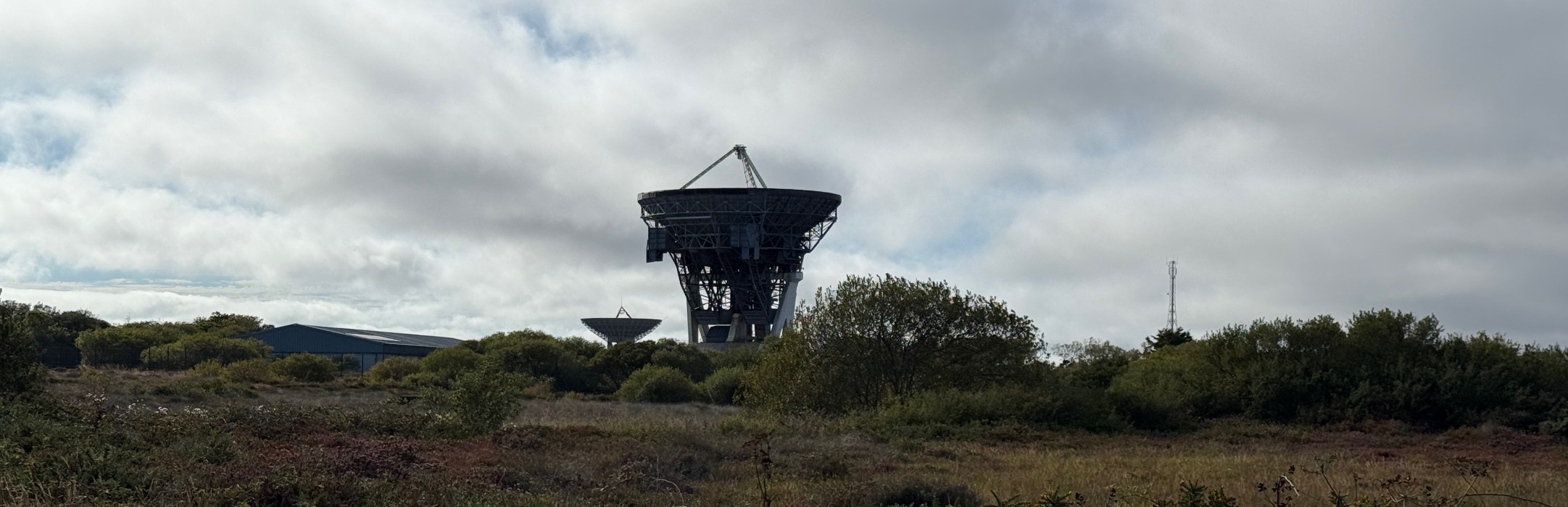
Goonhilly Downs are located on a large flat plateau in the middle of Lizard Peninsula. The landscape is largely open heathland with a few trees here and there. It is the habitat of much wildlife and fauna.
Beneath the surface is granite, and lots of it. This is one of the hardest stones known to man and it means that the ground is stable. It’s also radio active, but not enough for prolonged contact to be a danger.
It is the solidity and stability of this rock that the Post Office chose to site their new satellite earth station on in the 1960s. That and its remoteness and electrical silence – you need a very ‘quiet’ location to successfully receive signals from space.
Goonhilly Earth Station was built in 1962 and has been at the forefront of communications developments ever since. It received the first ever transatlantic television broadcast and was instrumental in providing NASA with communications links to the Apollo missions including the beaming of Neil Armstrong’s first steps on the moon. It was used as part of the communications system for the recent NASA trip around the moon. Goonhilly went on to become the largest satellite earth station in the world during the 1970s.
Post Office Communications became British Telecom (BT) when it was privatised and ownership of the site transferred with it. BT established an education centre at the site and this was very popular with families. It was doubtless responsible for recruiting lots of young folk into the growing space-related electronics, computing and communications industries.
Sadly, BT saw fit to withdraw operations from Goonhilly in 2008 and move north to their existing site in Herefordshire. However, that was not the end of Goonhilly Earth Station, or its large array of satellite dishes and accompanying infrastructure. Goonhilly Earth Station took over the site in 2014 and continues to develop the site and its business, winning large contracts from some of the world’s most important organisations and institutions. Sadly the education centre no longer exists which, I personally believe, is a missed opportunity in recruiting much needed raw talent from the UK into the industry.
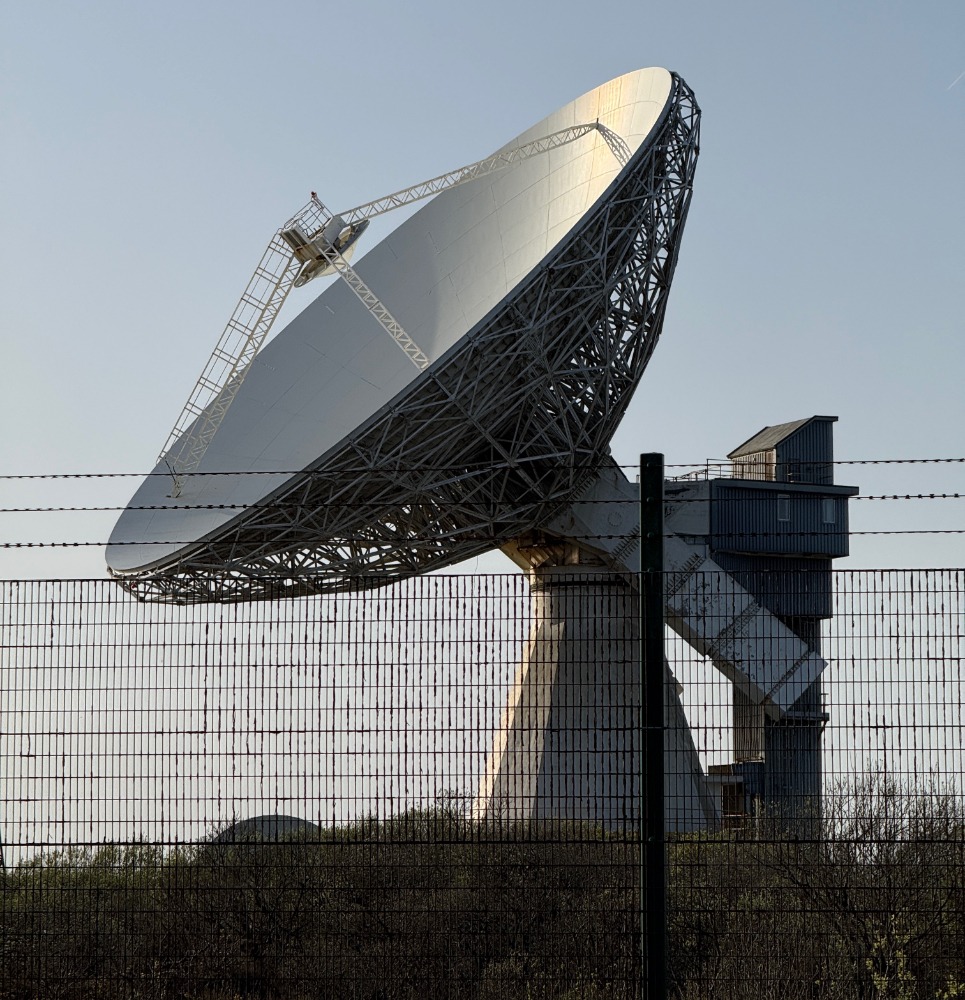
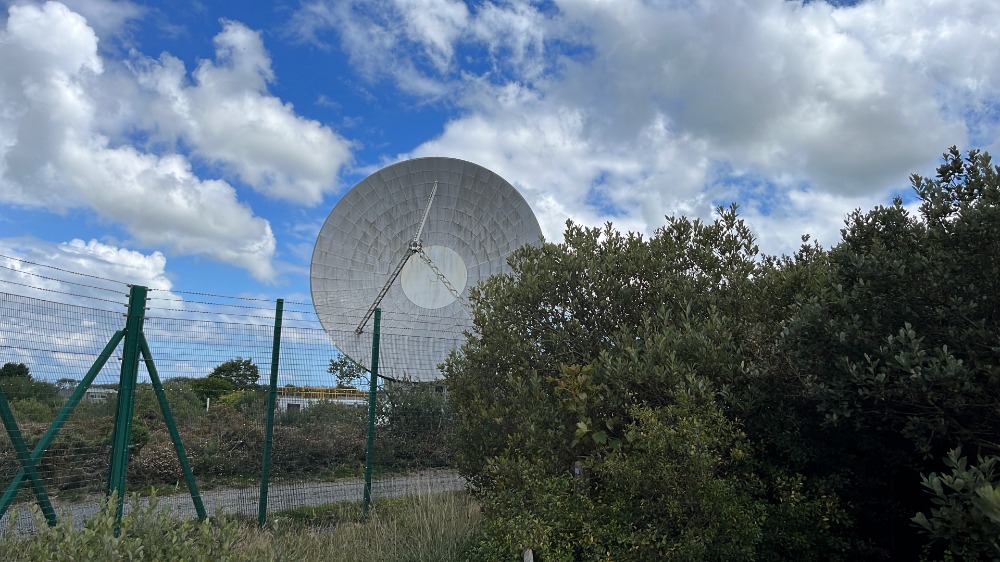
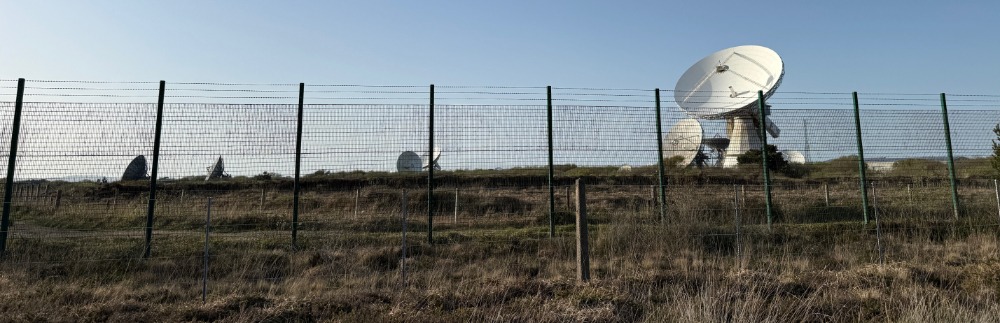
Several of the satellite dishes are named after Arthurian folklore characters as the area lays claim to being the site of the lake where King Arthur’s sword resides. Arthur was the first dish, whilst Merlin is the largest. Guinevere, Tristran and Isolde are smaller, but nonetheless important. Arthur and Guinevere are both Grade II Listed Structures.
The dishes sit proud of the surrounding countryside and can be seen from miles around. Fittingly, look east from Wireless Point, near Porthcurno, on a clear day and the dishes can be seen – seemingly motionless but doing an incredibly important ’thing’.
Details of my GB-5932 Marconi Monument, Grounds & Centre Activation
Callsign used
G7LFC
Date
13th August, 2026
Weather conditions
Broken cloud with sunny intervals, threatening rain, twenty two degrees with a moderate to strong breeze. The rain never came fortunately, though I suspect other areas of the Lizard Peninsula di get some looking at the angry skies to too far distant.
Equipment used
Icom IC-705, mAT-705 Antenna Tuner, Totalcool GP09 38,000mAh/144Wh power station (discontinued), Icom LC-192 back pack, cheap Chinese 5.6M/18.3 FT QRP Antenna, 14″ Lenovo IdeaPad Flex 5 Core i7 with 16GB.
Software used
HAMRS Pro logbook, WSJT-X 3.0.1 64-bit datamodes software, BktTimeSync for time synchronisation, Microsoft Windows 11 and HamDeck Grid Distance Calculator.
Bands, modes and power used
17 and 15m using 5w of FT8.
Station setup
The station was setup on a picnic bench at the entrance to the reserve from the car park beside Goonhilly Earth Station. The counterpoise radials were all laid in a southerly direction from the antenna, due to shortage of space to equally space then around the antenna.
Notable contacts
Two contacts into the US was a fairly respectable accomplishment from here with the radials all bunched together. But, as always, thanks to everyone I worked, without you I would not be chalking this activation up as a success.
How did the activation of GB-0668 Goonhilly Downs Nature Reserve go?
My activation of the site took place from the Goonhilly Downs Lizard National Nature Reserve visitor car park adjacent to Goonhilly Earth Station. As you leave the car park to walk around the reserve there is a wooden picnic bench within a small area of grass. It being late in the afternoon I figured that nobody would be requiring it for their picnic, so I borrowed it for a while.
I set up my antenna a few feet behind the table and laid all of the counterpoise wires in a southerly direction as there wasn’t space to fan them out 360 degrees around the antenna. It was rather strange operating away with my cheap Chinese 18′ antenna, next to these behemoths of the communications world. However, operate I did and quite successfully if I may be so bold as to say so myself.
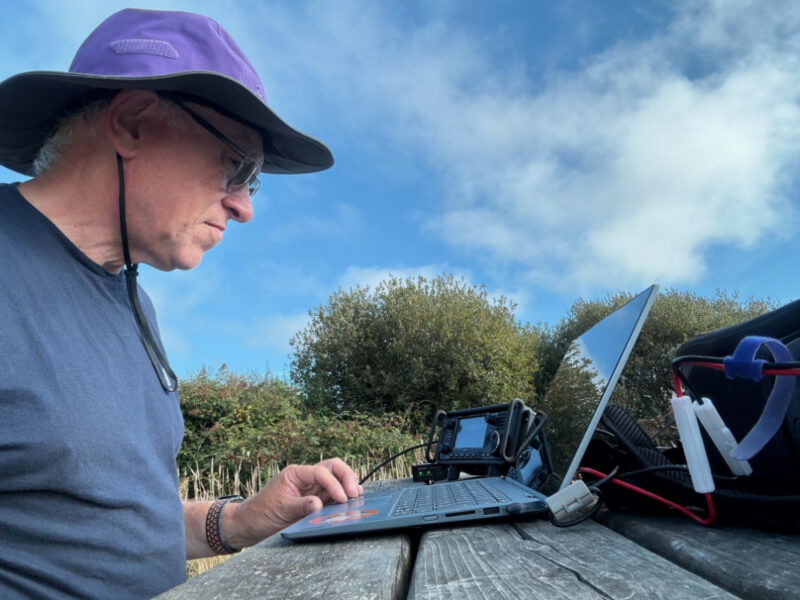


The wind was quite a bit stronger than it was whilst I was activating the Poldhu site earlier in the afternoon. Here the antenna was leaning consistently at about 30 degs from vertical. And this whilst the antenna’s ground spike was only inserted about 1.5” to 2″ into the ground – I could get it any deeper.
The activation took an hour to complete just ten contacts. I had problems operating on 20m because of RF breakthrough, so I had to make do with 17m and 15m, there was nothing to be heard on 12m and 10m – it was getting on into the evening after all.
By the time I’d made the tenth contact, just before 19:00 (local), it was getting close to the time after which I cannot eat anything due to the problem I have with my oesophagus. So I quickly packed up and retreated back to the car where Ali, my long suffering wife, was waiting with a ham salad. She had been amusing herself with some cross-stitch whilst I’d been operating.
Pros and cons
If the picnic table isn’t available I’d certainly recommend operating from the car at this site. I would ordinarily find a space to put down my KitBrix KitMat and get on with operating whilst sitting on the floor at a place like this. However, this area is renowned for snakes and grazing sheep. I am not best friends with snakes and I really don’t want to be extracting ticks from my legs – I almost always wear shorts during the summer months.
Other than that, I feel you must use low power at this site and keep away from the fence that separates the nature reserve from the earth station. This is a commercial communications site and we don’t want to be causing interference to them. The 5w I was using was certainly enough to breach the Atlantic Ocean, so five’s enough.
Observations and lessons learned
How did the antenna stay upright? I’ll never know, but I am becoming increasingly impressed by these tough little cheap Chinese antennas. I will push it too far at some point, but they’re so cheap that I keep a spare in the van at all times.
GB-0668 Goonhilly Downs Nature Reserve Map & Logbook
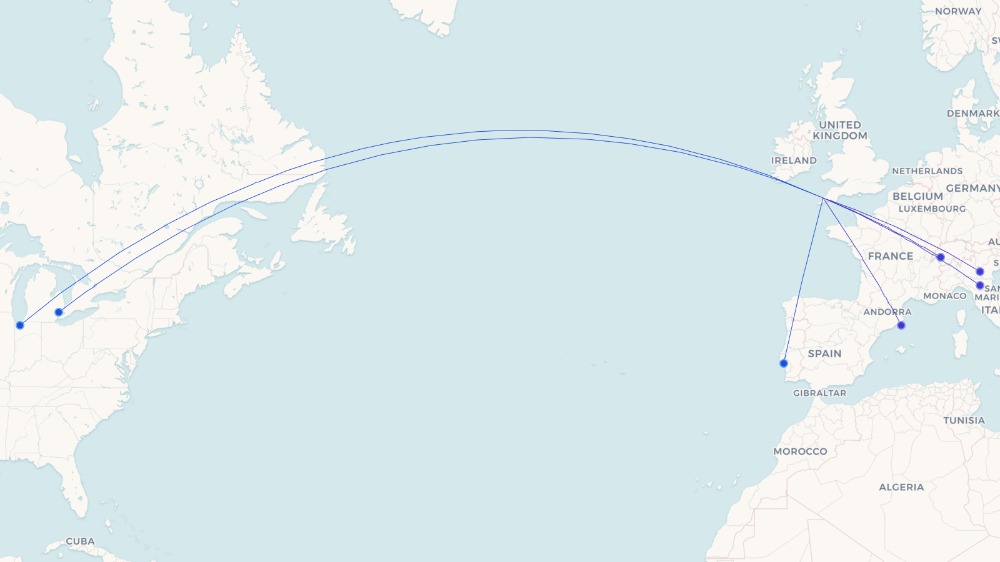
| Callsign | Date | Time | Band | Mode | RST Tx | RST Rx | Locator | Power |
|---|---|---|---|---|---|---|---|---|
| CT7AIC | 20260813 | 165245 | 17m | FT8 | -01 | -07 | IM58 | 5 |
| N2BJ | 20260813 | 165511 | 17m | FT8 | +09 | -18 | EN61 | 5 |
| NE8Z | 20260813 | 165630 | 17m | FT8 | -05 | -13 | EN82 | 5 |
| IK4LZH | 20260813 | 171130 | 15m | FT8 | +09 | +03 | JN54 | 5 |
| F4DIA | 20260813 | 171300 | 15m | FT8 | +01 | -05 | JN36 | 5 |
| EB3DBR | 20260813 | 171430 | 15m | FT8 | +07 | -12 | JN11 | 5 |
| RN6MA | 20260813 | 173415 | 17m | FT8 | +12 | -14 | 5 | |
| IN3BFW | 20260813 | 173930 | 15m | FT8 | +15 | +11 | JN55 | 5 |
| CR5VP | 20260813 | 174432 | 15m | FT8 | +10 | -20 | 5 | |
| EA8AT | 20260813 | 175645 | 17m | FT8 | +02 | -18 | 5 |