
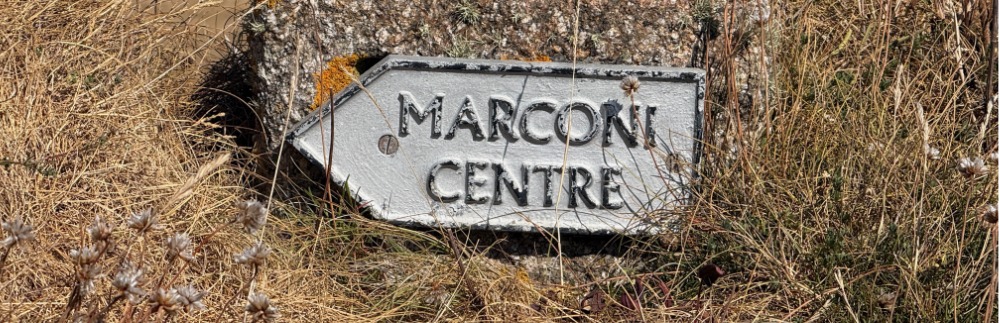
Jump to GB-5932 Marconi Monument, Grounds & Centre Details of Activation and Logbook.
This was the third of my five activations of historic communication sites in Cornwall – each one of them conveniently located in an official Parks on the Air (POTA) or UK Bunkers on the Air (UKBOTA) location:
- 09/08/2026 – GB-0264 Lizard Wireless Station
- 10/08/2026 – GB-0264 Wireless Point
- 13/08/2026 – GB-5932 Marconi Monument, Grounds and Centre at Poldhu
- 13/08/2026 – GB-0668 Goonhilly Earth Station
- 15/08/2026 – B/G-1507 Porthcurno Telegraph Station
Marconi at Poldhu
Poldhu is located on the western coast of the Lizard Peninsula, just south of Helston, in Cornwall. Today, up on the southern cliff, above the cove’s beach, can be seen a large multi-floored care home. Back in 1899, however, this was the newly built Poldhu Hotel.
Behind this hotel, Guglielmo Marconi sited his famous Poldhu Wireless Station, whose transmitter would send the three dits that would breach the Atlantic Ocean. Whilst located on Signal Hill, in Newfoundland, Canada, Marconi’s reception of that single letter changed the world forever. It was common belief that radio waves travelled in a straight line and that, once they had reached the horizon, they simply carried on going out into space.
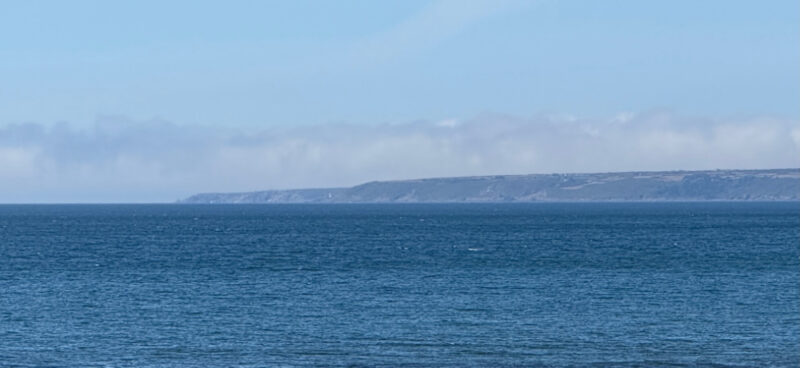

However, months earlier, Marconi had already disproved this popular theory. He had successfully transmitted a signal from a site on the Isle of Wight to his Lizard Wireless Station, at the tip of the Lizard Peninsula. Now he had successfully sent a wireless radio signal over many thousands of miles a quarter of the way around the world.

Marconi’s whiskey?
By the way, did you know that there is a very nice whiskey produced at Signal Hill called, appropriately, Signal Hill Whiskey. I stumbled across it whilst I was bored during Covid and bought one. Not that I like whiskey, I’m not a huge fan, it was bought for the novelty. However, I did taste it it and thought it quite palatable for my untrained tongue, so finished it off. I’ve had a bottle in stock ever since for those odd moments when I fancy a tipple. Anyway, I digress.
Marconi’s Poldhu station
The Poldhu station, of some fifty-acres, was purchased in 1900. Construction of the station started later that year and continued until January 1901. The antenna consisted of twenty masts arranged in a circle from which the wires that made up the antenna were suspended. Unfortunately, a storm in the middle of September 1901 destroyed the antenna. However, Marconi’s team was not to be deterred and within seven short days they had erected a much simpler fan antenna, suspended between just two 48m high masts. The transmitter was capable of delivering between ten and thirteen kilowatts of RF power, depending on who you read.
I have seen it written, but cannot remember where, that whenever the transmitter was keyed up, gutters and metal windows would rattle on houses for miles around. Being of the spark gap type, the transmitters used an awful lot of the radio spectrum known to the radio engineers of the day.
Breeching the Atlantic
By December 1901 Marconi, and his assistants, were in Newfoundland. The Poldhu station had instructions to transmit the letter ‘S’ in Morse code every day between 3:00 and 6:00 pm local time. With the time difference taken into account, this would equate to three hours centred around lunch time. I’m guessing that nobody understood the effects of transmitting on the grey line, but at that time of the year the grey line would have been firmly over Cornwall, enhancing east-west propagation. One wonders whether they would have had the same success if they had tried this experiment at the height of the summer.
On the 12th of December, one of Marconi’s assistants recorded that the letter ‘S’ had been received repeatedly on Signal Hill.
Poldhu, the centre of experimentation and development
The station at Poldhu continued to be developed with further antennas erected on the site. Experiments led to the establishment of a regular telegram service with Glace Bay, Nova Scotia, in Canada. This was eventually replaced by a permanent station being built in County Galway, Ireland, to take over the service. The Poldhu station took up the mantle of a ship-to-shore station capable of communicating with ships way out in the Atlantic Ocean. As well as handling business communications and telegrams for passengers, the service also transmitted news to the ships that could be included in their daily newspapers that were printed on-board.
During the First World War the site was put to use by the Royal Navy. No doubt it was used to send encrypted traffic to its warships in pursuit of the Germany Navy’s ships and wold pack submarine fleets.
Following the war the site was used to perform directional transmitting, resulting in the establishment of the Beam Wireless Service for the British General Post Office. This meant that RF power could now be channelled into a single direction to establish reliable point-to-point wireless radio links. Similar stations were soon establish at Bodmin, linking to Canada, tetley, beaming to Australia, Bodmin, beaming to South Africa, Dorchester, beaming to India, and subsequently to Argentina, Brazil and the United States.
The end of Poldhu
In 1933, the Poldhu station was shut down and the site cleared completely within two years. The granite monument you see on the cliff side today was constructed in 1937 by the Marconi Company as a tribute to the work that was carried out on the site. If you wander around the site you can still see a number of concrete foundations and earth structures.
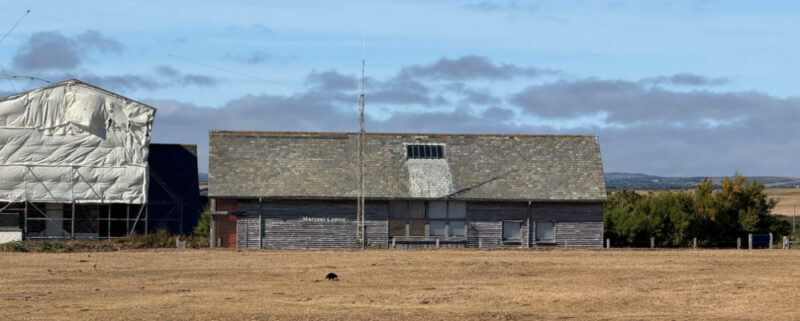
The land now belongs to the National Trust and the wooden Marconi Centre was built on it in 2001. It tells the story of Marconi’s achievements and is also home to the Poldhu Amateur Radio Club. In the fields closest to the centre are modern day antennas used by the club’s members and for demonstration to the public.
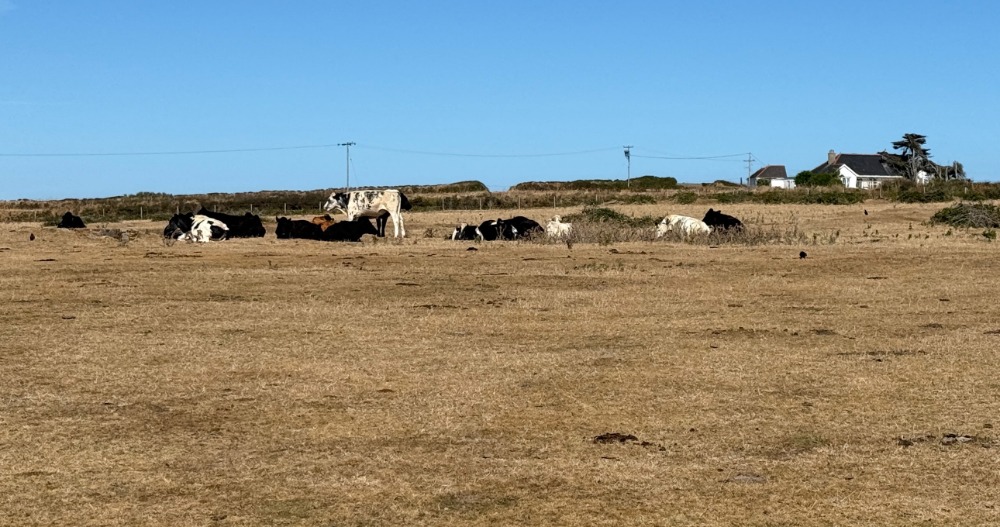
The land is open to the public to explore, but is also used to graze cattle and sheep at various times. More anon.
Details of my GB-5932 Marconi Monument, Grounds & Centre Activation
Callsign used
G7LFC
Date
13th August, 2026
Weather conditions
Sunny, twenty four degrees with a moderate on shore breeze.
Equipment used
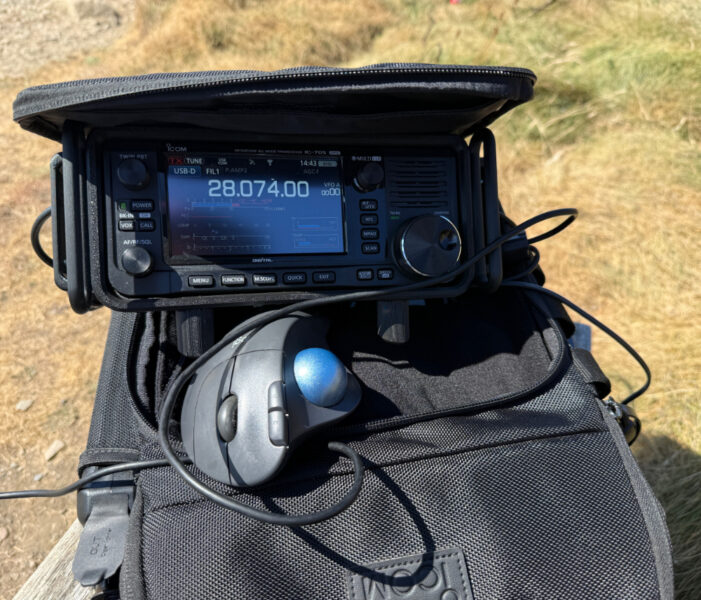
Icom IC-705, mAT-705 Antenna Tuner, Totalcool GP09 38,000mAh/144Wh power station (discontinued), Icom LC-192 back pack, cheap Chinese 5.6M/18.3 FT QRP Antenna, 14″ Lenovo IdeaPad Flex 5 Core i7 with 16GB.
Software used
HAMRS Pro logbook, WSJT-X 3.0.1 64-bit datamodes software, BktTimeSync for time synchronisation, Microsoft Windows 11 and HamDeck Grid Distance Calculator.
Bands, modes and power used
17m, 15m, 12m and10m using 5w of FT8.
Station setup
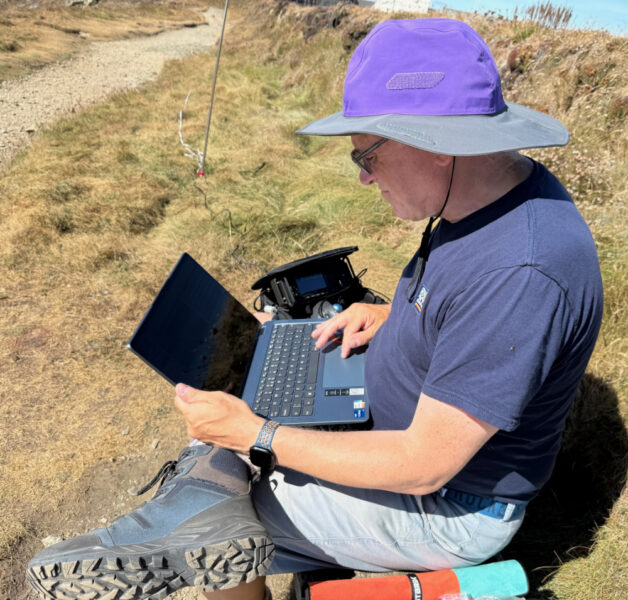
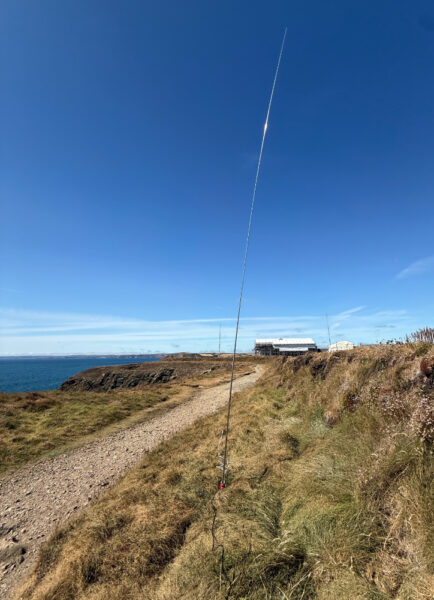
The station was setup on a bench adjacent to the Marconi monument at Poldhu. The South West Coastal Path that the monument is located on it very busy and the monument itself attracts a lot of interest. As a result I tried to keep out of their was as much as possible and sited the antenna on a thin piece of grass that runs alongside the stone wall. The radials were all laid in th same direction, parallel with the wall so as to not present a trip hazard to anyone.
Notable contacts
Contacts to the Azores and Turkey were respectable given the compromised antenna and installation. The rest of the contacts were made with ‘near’ European stations. Id stress, though, that I’m grateful to all the stations I work regardless of how far, or near, they are – without them I would not be able to enjoy my hobby. So a big thanks to you all.
How did the activation of GB-5932 Marconi Monument, Grounds & Centre go?
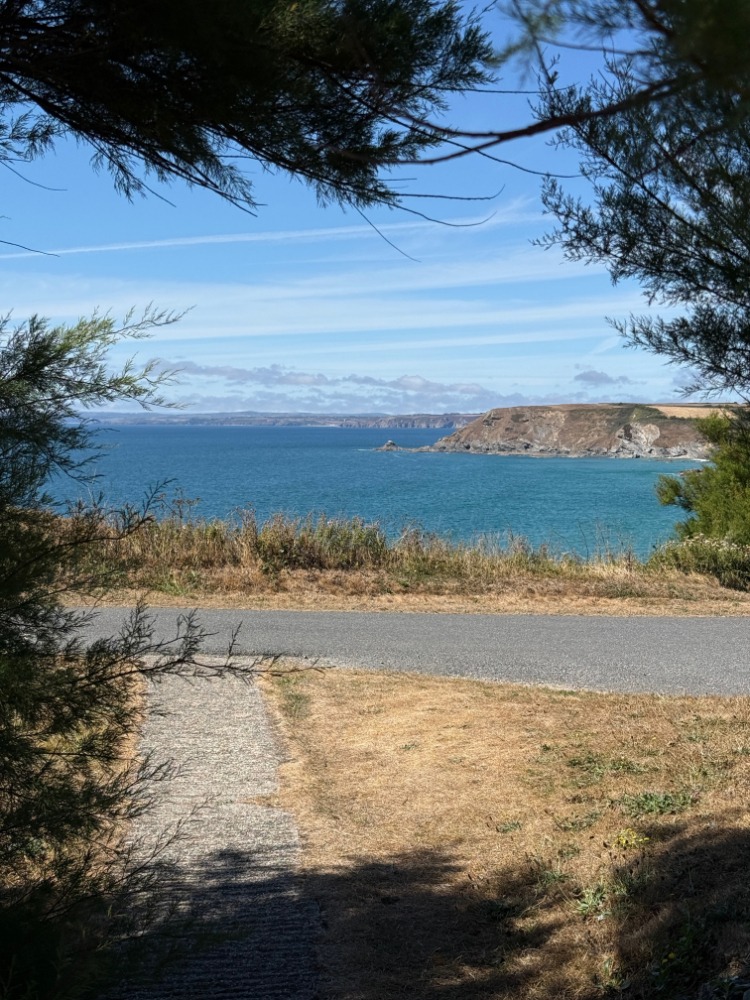
If you take the road at the side of the beach up towards the care home (ex. Poldhu Hotel) there is a small car park set aside for visitors to the GB-5932 Marconi Monument, Grounds and Centre. It is owned by the National Trust, as are all the grounds and the centre, but is free of charge.
We made a slight detour back down the drive to the beach cafe for a quick snack – they do an excellent fruity smoothie. They also do their own range of Pholdu Cove clothing and accessories. Last year they were selling a very nice hoodie with full colour graphics printed front and back and I did purchase one. Sadly, this year’s range is a little less exciting and I saved some money.
Suitably refreshed, we headed back up the drive that is not too steep. Ali, my long suffering wife, has a dodgy hip and she was fine with it. Past the car park you will find, what looks like, a typical government laid concrete path that leads up to the Marconi Centre and antenna field.
The centre is only open on a Sunday afternoon from recollection, but it certainly wasn’t open on the Thursday when we visited. The centre’s manned by volunteers from the Poldhu Amateur Radio Society, and not the National Trust, so they’re very knowledgeable about the technical side of things.

When I last activated this famous communication site, during the summer of 2025, I chose to operate at one of the concrete blocks, that supported Marconi’s antennas, in the middle of the field. I thought this was a fitting tribute to the work that this piece of concrete had performed during its operational life. Silly, I know, but I’m a sentimentalist at heart. However, I hadn’t counted on the young cattle about half a mile away being so inquisitive. As I operated I observed them getting ever closer until I thought I had no choice but to abandon my radio station and retreat a safe distance away from this heavy duty heard.
The cattle left nose prints on my laptop screen and cow drool on my transmitter. However, my greatest fear was not realised. They moved between, and around, the concrete block and my fragile £20 Chinese antenna with great aplomb. They did not drag the coaxial cable, and with it my Xiegu G106 transceiver to the ground and trample it into the soft mud. Neither did they knock over the antenna and render it a useless coat hanger. In fact, the only casualties were two of the eight radials laid out around the antenna.
As we entered the field for this activation, the herd was the first thing that was checked for. It being a gloriously warm and sunny summer day, the herd was quickly found to be relaxing, lying down, by the foundations of one of the buildings that had been demolished in 1937. I gave them the due respect they deserved, I was a visitor to their world after all. We made for the gate in the wall by the monument that bears testimony, to all that walk by it along the coastal path, of the work that went on in the field over one hundred years ago.
On the other side of the wall is a bench and Ali, my long-suffering wife, and I occupied it for about an hour. Ali produced a watercolour of the monument whilst I set up and operated my station. I was careful to keep everything shaded this time as my mobile phone had overheated during my activation of the Isles of Scilly a couple of days earlier.
The antenna used for this activation was the same £20 cheap Chinese vertical antenna I used during the previous activation. It consists of a ground spike into which is screwed a red transformer with the radials sat in between. Into the top of the transformer block is screwed an 18’ telescopic whip. It is a compromise antenna, but it does work.
The wind for this activation was what I would call a moderate breeze. Strong enough to have the antenna at fifteen to twenty degrees from vertical throughout most of the activation. However, my continued concern over its fragility might be misfounded as it survived to live another day to perform my next activation.
The only land I had to run radials on was a small strip of sunburnt grass alongside the wall. As a result all eight of them were laid running to the north west of the antenna, which is a further compromise from having them equally spaced out around the antenna.
As a result of using a compromised compromised antenna, I thought I would struggle to make the required contacts, especially with the radiating element swinging about all over the place. However, twenty contacts were made in a little over and hour (69 mins to be exact) resulting in one contact every three minutes-ish. Not too shabby as it turned out.
What was interesting was that all of the stations worked were between ENE and SWS (clockwise) of my location. Running all the radials in the same direction, NW, had turned my omnidirectional vertical antenna into a directional vertical antenna with an equivalent beam angle of about 120 degrees. Theory proven.
After this activation, it was off to GB-0668 Goonhilly Downs Nature Reserve for another activation.
Pros and cons
It would have been nice to actually operate in the same field as Marconi did, but sometimes you have to cut your losses and be pragmatic. Operating outside the field’s perimeter does present you with a conundrum as to were to site your antenna, but this activation has proven that, even with all the compromises you have to make, you can still make contacts. As it turned out, it was a great place to operate from, the views across St Michaels Bay to West Penwith (Penzance around to Porthcurno) are magical – and the sound of the sea crashing into the cliffs beneath you mesmerising.
Observations and lessons learned
I think one of the things that has amazed me during my ownership of this cheap Chinese £20 antenna is how it has worked – almost as well as a single band Ampro plonked on the top of the roof of my van. It’s never let me down. It is light, easy to carry, and has stayed upright even in the moderate breeze it was presented with during this activation. I think it’s performed better than any £20 antenna has any right to do.
My observation is this – never underestimate a piece of equipment, just because it’s cheap. Now I have to get that cheap Chinese uSDX HF transceiver working during the autumn – it was cheap at less than £100. That’s £60 cheaper than my 5w Xiegu G106 that I bought new from Martin Lynch a couple of years ago and it performed very well until the G90 turned up from the same manufacturer. Maybe this is a step too far in terms of how cheaply you can put a station together to work overseas radio amateurs, but we will see.
GB-5932 Marconi Monument, Grounds & Centre Map & Logbook
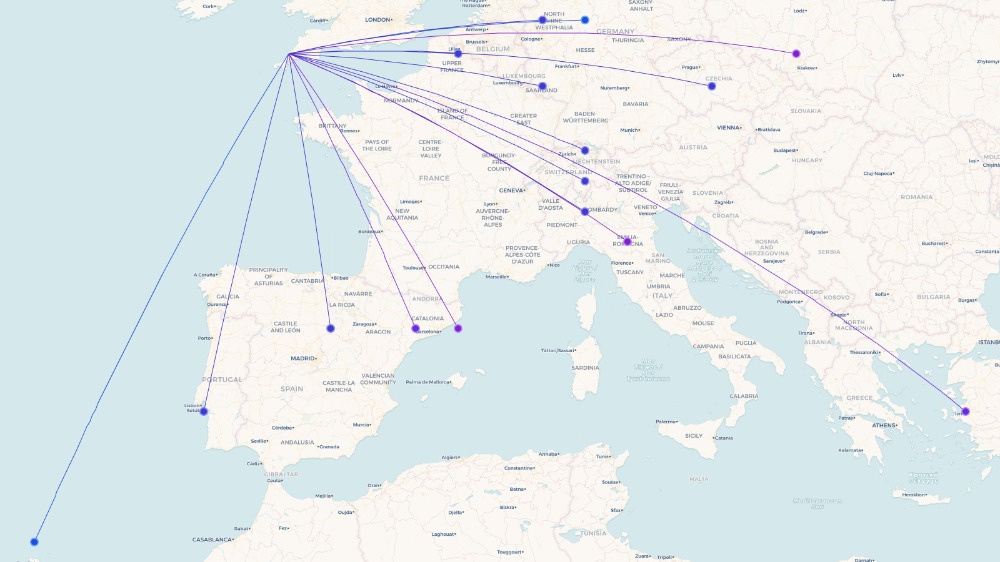
| Callsign | Date | Time | Band | Mode | RST Tx | RST Rx | Locator | Power |
|---|---|---|---|---|---|---|---|---|
| HB9EFK | 20260813 | 142200 | 15m | FT8 | -01 | -14 | JN46 | 5 |
| OK1ZJK | 20260813 | 142430 | 15m | FT8 | +08 | -12 | JN79 | 5 |
| F4HTA | 20260813 | 142600 | 15m | FT8 | -07 | -08 | JO10 | 5 |
| F4FHM/QRP | 20260813 | 143445 | 12m | FT8 | +16 | -01 | 5 | |
| TC3CT | 20260813 | 143745 | 12m | FT8 | -12 | -21 | KM38 | 5 |
| EA3HKA | 20260813 | 144100 | 10m | FT8 | +06 | -16 | JN11 | 5 |
| IK4LZH | 20260813 | 144230 | 10m | FT8 | +12 | -01 | JN54 | 5 |
| SP9MOC | 20260813 | 144715 | 10m | FT8 | -12 | -21 | JO90 | 5 |
| DG8DAX | 20260813 | 145215 | 15m | FT8 | -10 | -21 | JO31 | 5 |
| IK4LZH | 20260813 | 145430 | 15m | FT8 | +12 | -08 | JN54 | 5 |
| I4BUQ | 20260813 | 150045 | 17m | FT8 | +01 | -11 | JN54 | 5 |
| DD7EE | 20260813 | 150330 | 17m | FT8 | +05 | -04 | JO41 | 5 |
| IW2CAK/2 | 20260813 | 151400 | 12m | FT8 | +11 | -13 | 5 | |
| EB3JT | 20260813 | 151500 | 12m | FT8 | -08 | -09 | JN01 | 5 |
| EG5DX | 20260813 | 151800 | 15m | FT8 | +04 | -08 | IN81 | 5 |
| CR7BRV | 20260813 | 152100 | 15m | FT8 | +16 | -15 | IM58 | 5 |
| F5NAA | 20260813 | 152224 | 15m | FT8 | -07 | -07 | JN39 | 5 |
| IK2DUW | 20260813 | 152415 | 15m | FT8 | -01 | +01 | JN45 | 5 |
| HB9XBY | 20260813 | 152645 | 15m | FT8 | +02 | -19 | JN47 | 5 |
| CT3MD | 20260813 | 153100 | 17m | FT8 | -03 | -20 | IM13 | 5 |