
Jump to B/G-1507 Porthcurno Telegraph Station Tunnels Details of Activation and Logbook.
This was the fifth, and last, activations of historic communication sites in Cornwall – each one of them conveniently located in an official Parks on the Air (POTA) or UK Bunkers on the Air (UKBOTA) location:
- 09/08/2026 – GB-0264 Lizard Wireless Station
- 10/08/2026 – GB-0264 Wireless Point
- 13/08/2026 – GB-5932 Marconi Monument, Grounds and Centre at Poldhu
- 13/08/2026 – GB-0668 Goonhilly Earth Station
- 15/08/2026 – B/G-1507 Porthcurno Telegraph Station
Porthcurno Telegraph Station
The Falmouth, Gibraltar and Malta Company was founded in 1869. The intention was to link Great Britain o India using telegraph cables. Unfortunately, the cable was never laid into Falmouth. This might have been because Falmouth was a busy shipping port and the thought of having to repair the cable every so often when a ship dragged its anchor over it was thought to be too big a risk – that’s my theory. The decision was made to land the cable at Porthcurno, a few miles east of Lands End. In June 1870 the final length of cable was landed in the cove and connected to the cable station that had been built there. The cable station’s callsign/station identifier was PK and many still refer to Porthcurno thus.
Three years later the company was merged with other companies to form the Eastern Telegraph Company. This became the largest cable telegraphy company in the world and Porthcurno the most important place on earth. It was now the communications hub for the British Empire.
As you can read in my activation report of Wireless Point, everything was going well for the telegraph company, and Porthcurno, until a young upstart called Marconi landed in Cornwall. Over on the Lizard Peninsula he was experimenting with wireless radio communications. The long and short of it was that, after a period of concern and industrial espionage (together with a bit of skullduggery) the telegraph company did not deem wireless to be a serious risk to their business. The irony is, though, that they actually embraced wireless communication and set up a radio station at Wireless Point to handle traffic between the mainland and the Isles of Scilly.
In 1934, the telegraph company and Marconi’s wireless business were merged to create the giant that was to become Cable & Wireless.
Cable was seen as an acceptable target during times of war. If enemy cables could be cut their communications channels could be disrupted. Furthermore, if that cable could be redirected to your own shores, then it could be used to your own advantage. During the first few days of World War I the Royal Navy cut five German cables.
By the start of World War II, 14 cables came ashore at Porthcurno carrying some 70% of communications with Britain. Realising how vulnerable the cable station was to enemy attack, the decision was taken to sink tunnels into the cliffs and move all critical operations underground.
After the war concluded the labour government of the day sought to bring vital infrastructure, utilities, and communications networks into public ownership in order to improve efficiency and centralise services. Accordingly, in 1947, Cable & Wireless was nationalised and taken into public ownership. The company’s British assets were handed over to the Post Office, whilst the international assets remained with Cable & Wireless. The Porthcurno telegraph station stayed under the control of Cable & Wireless and operational until 1970. The site was then transformed into its premier engineering college and trainees and staff would be sent there from all over the world to study cutting edge communications technologies – cable and wireless.
Cable & Wireless was eventually denationalised under the premiership of Margaret Thatcher in 1981 and once again was able to function as an independent company. Post office Telecommunications was to follow in 1984, becoming British Telecom (BT).
Telegraphy operations finished at Porthcurno in 1970, 100 years after it had started. However, Cable & Wireless’ presence continued in the valley in the form of their training college. Students came from world to learn cutting edge techniques in cable, wireless and satellite communication.
1988 saw the first undersea fibre optic cable land at Porthcurno. Rather than sending electrical signals down copper cables, laser light was sent down super fine glass cables. This not only enabled more data to be carried simultaneously, but the data could be transmitted at a much higher rate. The future of international communications had arrived. This new cable, however, was terminated at a new cable station at Skewjack, about a mile up the road. Today, six fibre optic cables come ashore at Porthcurno.
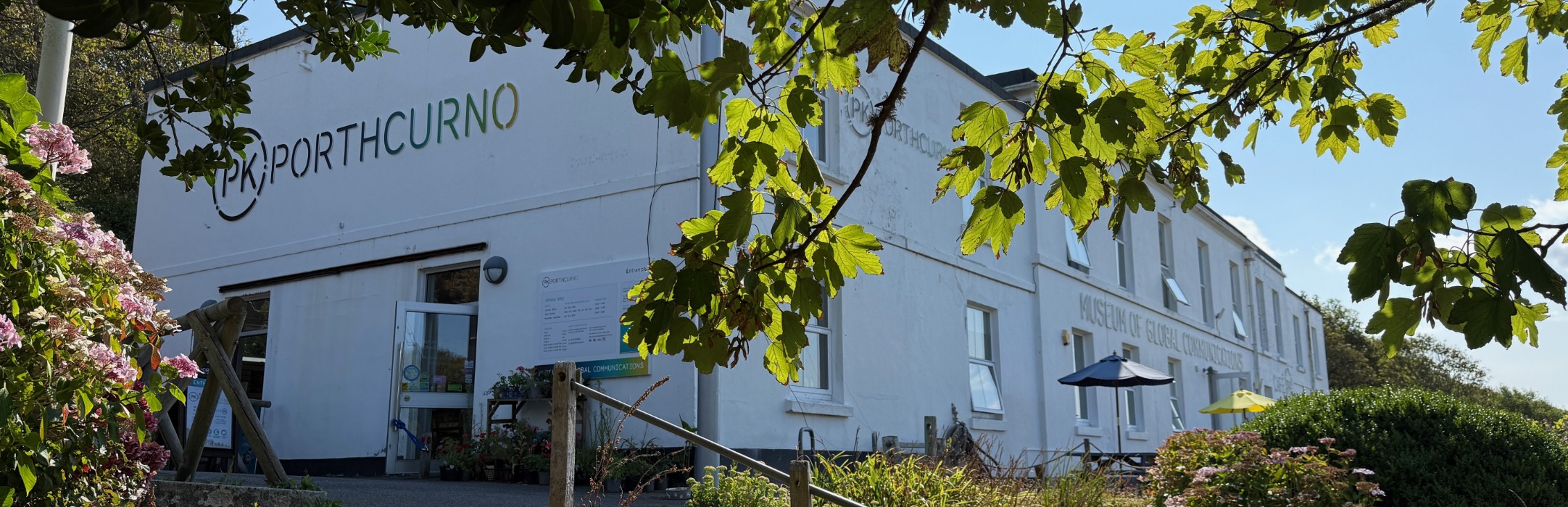
Porthcurno training college was deemed an expensive luxury and a new college was built in Coventry to replace it. Training concluded in Porthcurno in 1993. With the closure many historically significant artefacts came under risk of being lost forever. Fortunately, former Cable & Wireless staff members recognised this and saved them to form the basis of the museum’s unique collection. The collection includes the museum buildings, documents, artworks, photographs, working telegraph equipment and maps. The Cable & Wireless museum opened in 1998 and, following a major refurbishment, became the Porthcurno Museum of Global Communications in 2014.
Sadly, and quite seperately, Cable & Wireless became a major victim of the collapse of the telecommunications and dot-com bubble of the late 1990s and early 2000s. It was formally broken up in March 2010 to become Cable & Wireless Communications and Cable & Wireless Worldwide. These were were subsequently sold off in 2016 to Liberty Global and Vodafone respectively. Vodafone subsequently transferred the business archive of Cable & Wireless, an important resource for academics and family historians world wide to the museum.
The tunnels
Work on the tunnels started in mid 1940 and was completed within. year. Access to the valley was strictly limited and only holders of a Porthcurno Pass could come and go. Cable & Wireless operated very much as another branch of the armed forces during the war, providing and maintaining communication links throughout. In 1938 approximately 231,000,000 words were transmitted over Porthcurno cables. In 1944, this had increased to 705,000,000 words.
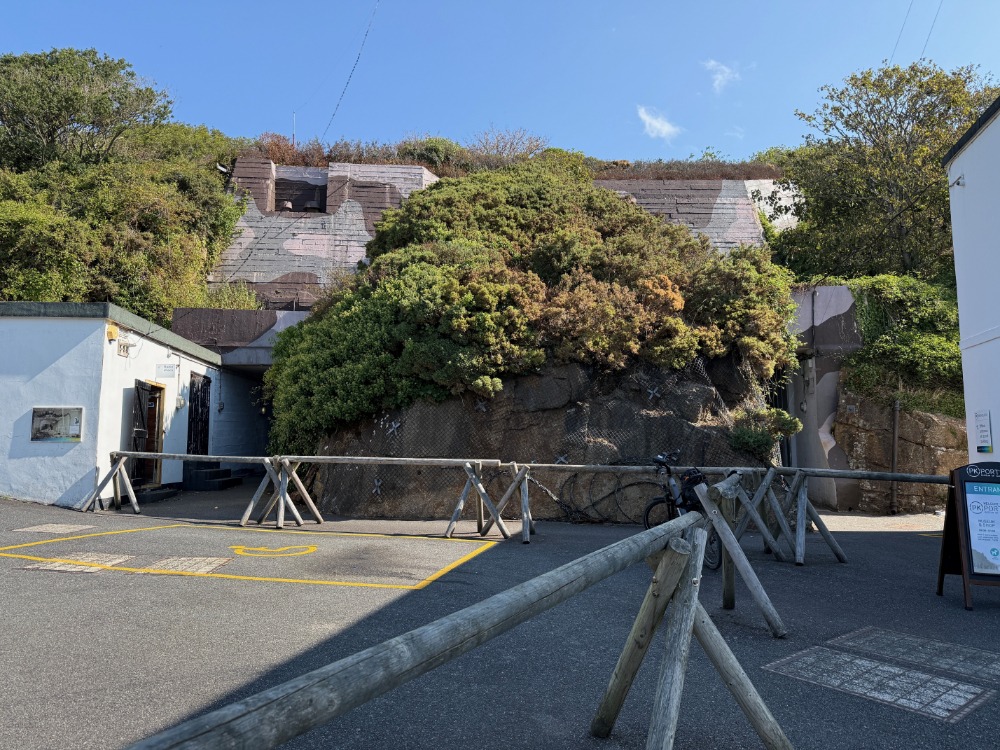
My operation from the radio shack of the Porthcurno Global Museum of Telecommunications was in order to activate the site for the UK Bunkers on the Air (UKBOTA) August Weekend Bunker Blast.
Since the mid to late 1800s, Porthcurno was one of the most important places in the world. Britain still had an empire and was one of the biggest influences in world affairs. The development of undersea cables had seen the time taken to communicate between home and far away places slashed from weeks, or months, to just minutes. Many of those cables landed at Porthcurno. Then came World War II in 1939.
The bunker this site is famous for is a pair of tunnels, built by local tin miners during the war. The fear was that the cable station, which linked Britain to the four corners of the globe, was too vulnerable to a concerted air attack. The Germans would have loved to have taken it out and isolate the British from her overseas allies, and the other parts of the world they had their designs on.
As a result, the station was moved under the cover of tons of solid granite. There was, of course, also the possibility that the Germans might attempt a daring raid on the station from the sea. Porthcurno is a remote steep sided valley and a u-boat could easily surface off the coast on a cloudy night to insert a team of commandos whose job it would be to sabotage the station. The British had, after all, successfully completed similar raids on German targets.
As a result the beach was heavily fortified with rows of underground flame throwers, traps and pill boxes fitted with heavy calibre machine guns. The head of the valley was also cut off so that only cleared residents could gain access to their homes.

I was stationed at Porthcurno, whose callsign/station identifier had been PK, in the early eighties. The tunnels were then used as education classrooms and workshops. My one lasting memory of the tunnels was learning to edit video and the tune “It’s raining again”, by SuperTramp, being played over and over again. I think it was that lecturer’s favourite track of the moment.
Today the tunnels contain working exhibitions that tell the story of how cable communications work, what damage the Germans did to the area during the war when they did attempt to the attack the station, how fibre optic cable works and an annual special exhibition on a communications related topic.
The emergency escape tunnel is well worth a visit. Located at the back of the tunnels, 120 steps cut into granite rock take you high up above the valley. These days there is a veranda along which you can walk to a Lands End / John O’ Groats style sign post. Here you can have your photograph taken with distances marked to other major Cable & Wireless stations around the world. The view from up here is very impressive.
Details of my B/G-1507 Porthcurno Telegraph Station Tunnels Activation
Callsign used
GB9PK
Date
15th August, 2026
Weather conditions
Sunny, 20 degrees temperature with a gentle breeze.
Equipment used
Icom IC-705, mAT-705 Antenna Tuner, EcoFlow RIVER 2 power station, Icom LC-192 back pack, 40m doublet antenna (supplied by PK), Microsoft Surface Pro 7 tablet with Kagwerks tactical case.
Software used
HAMRS Pro logbook, WSJT-X 3.0.1 64-bit datamodes software, BktTimeSync for time synchronisation, Microsoft Windows 11 and HamDeck Grid Distance Calculator.
Bands, modes and power used
20m, 17m, 15m and 12m using 5w of FT8.
Station setup
The station was setup in a corner of the radio shack at the entrance to the tunnels. The 40m doublet antenna was fed into shack using ladder line feeder cable and terminated on two porcelain insulators.
Notable contacts
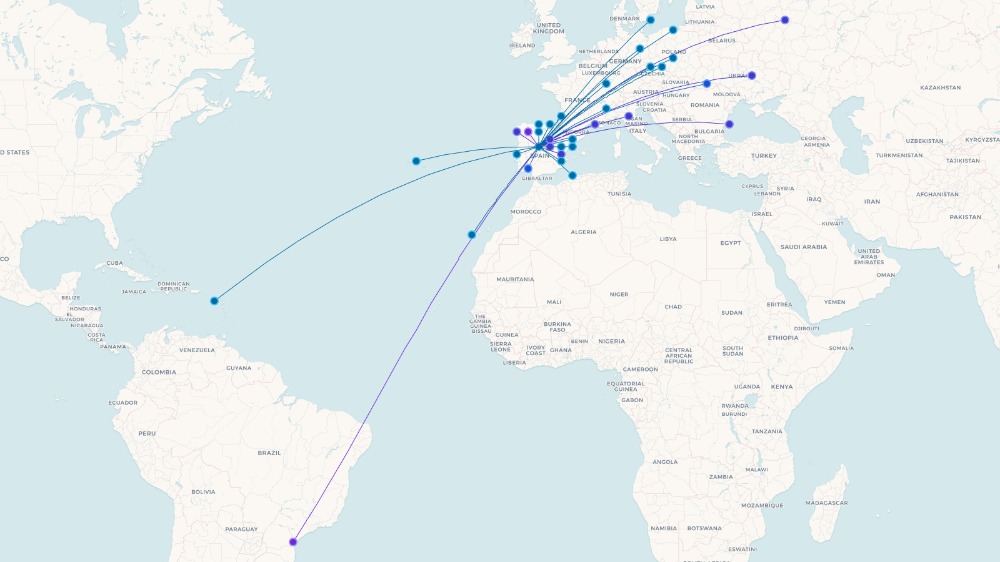
Four continents were worked that included contacts in to Cuba (North America), Brazil (South America), Algeria (Africa) and several European countries.
How did the activation of B/G-1507 Porthcurno Telegraph Station Tunnels go?
The weekend I activated the tunnels coincided with the UKBOTA Weekend Bunker Blast (WWB) which happened over the 14th to 16th August. The UKBOTA rules say that you can activate more than one bunker, providing you’re in the activation zone for each bunker. The activation zone for a UKBOTA bunker is 1000m. However, to qualify for a WWB award you can only submit contacts for one bunker at a time. As a result, I have a dilemma. Do I submit my contacts for multiple bunkers, or just one? I’ll let you know what I decide in the time it takes me to write the rest of this report.
The activation started at 11:00 local time (10:00 UTC) following a quick post on several Facebook groups.
I found I was able to work on 20, 17, 15 and 12m. Unfortunately, tuning up on 40, 30 and 10m caused the radio to lock up due to RF in the shack. This precluded any inter-GB contacts and was no doubt caused by the antenna coming in to the shack and running down the wall for some three feet.
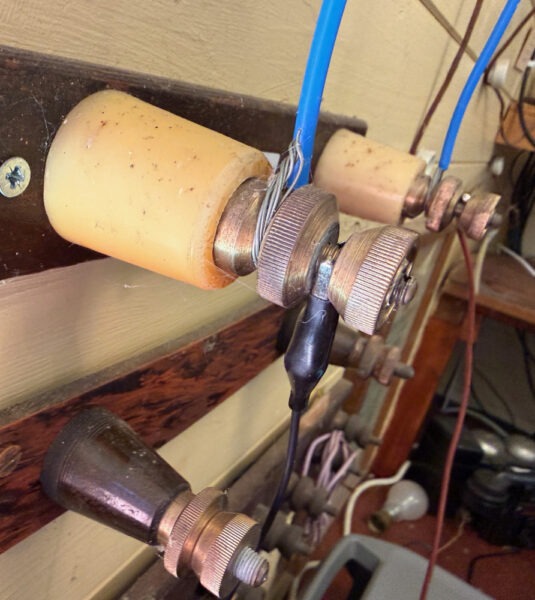
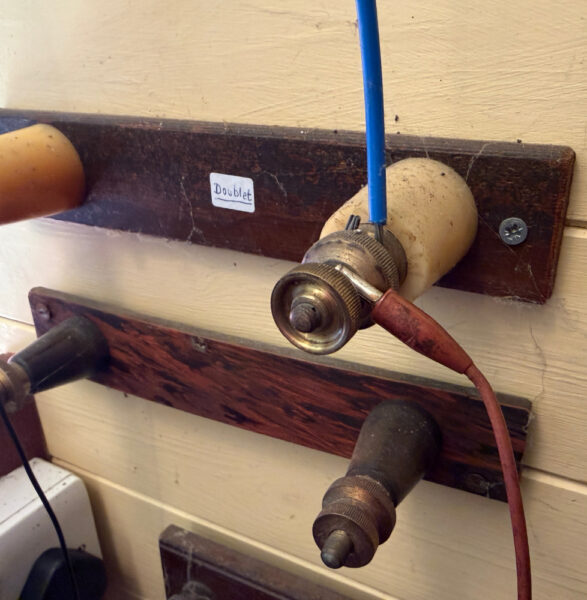
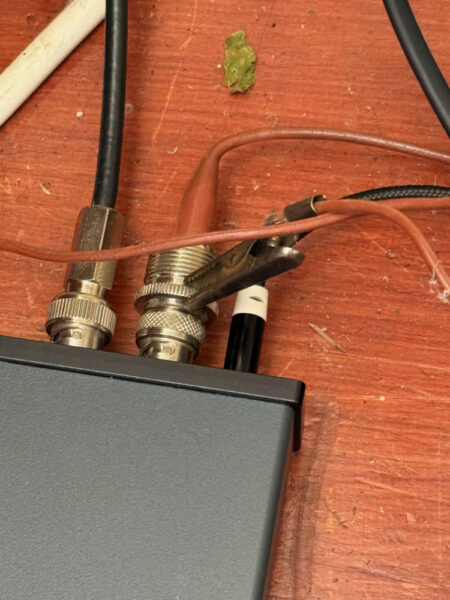
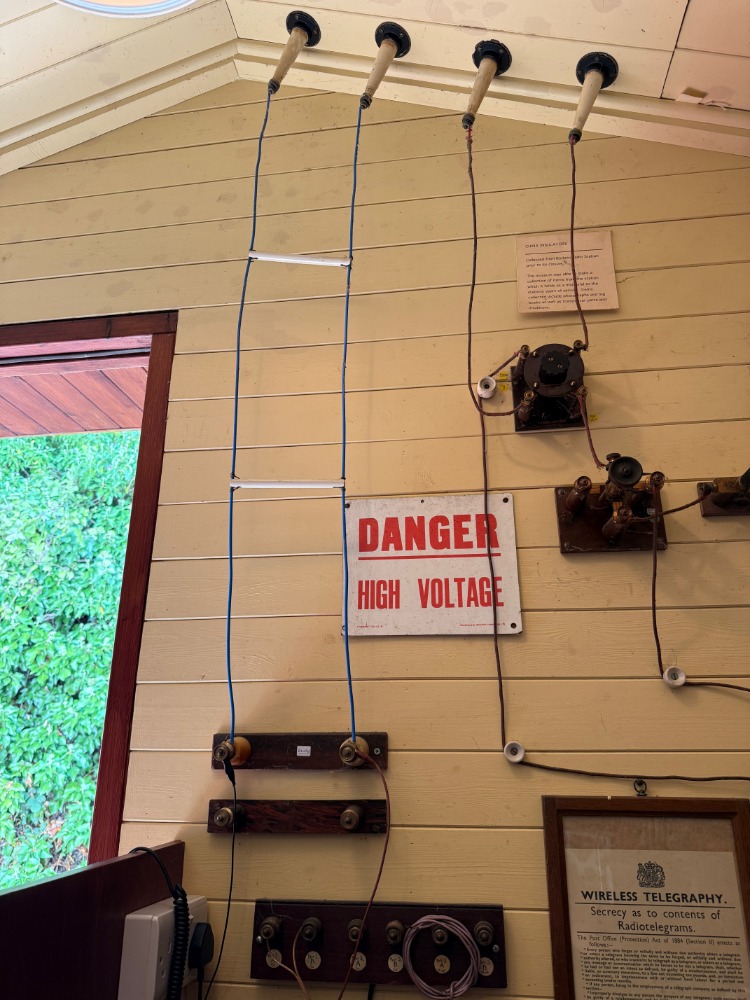
Furthermore, the connection of the antenna matching unit was a bit Heath-Robinson. As I had no way of converting a ladder line feed to the coaxial SO-239 (my manual MFJ Travel Tuner would have done it), I had to resort to inserting a single cable into the SO-239’s centre socket and connecting the other end to one side of the ladder line. Another single cable was attached to the shield of the SO-239 with a crocodile clip whilst being connected to the other side of the ladder line. Not very professional, but it did work and quite effectively too. Aside from not having access to the three aforementioned bands, the connections held up for the duration of the activation. I was only running 5w, I wouldn’t have tried this with 20+ watts.
By the end of the activation I had chalked up fifty contacts off the wire dipole antenna which was in an approximate NE – SW direction. This meant that the vast majority of the stations I worked were in Portugal, Spain and Italy. I did, however, manage a contact into Canada and Brazil – especially as the latter would have been almost off the end of the antenna.
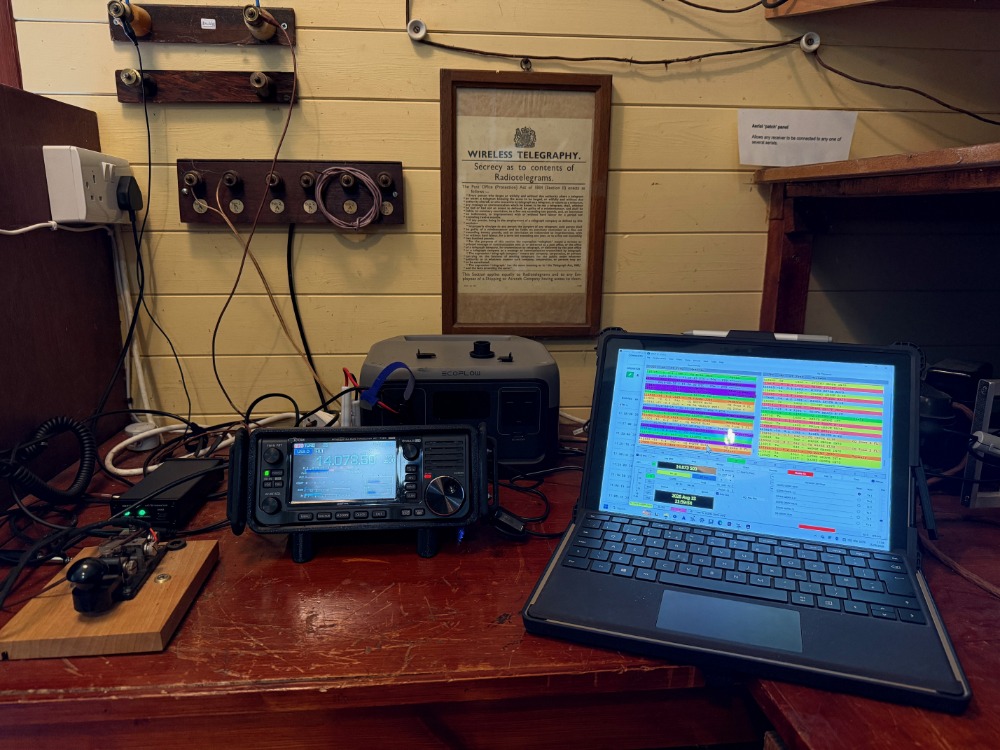
There was one rather poignant moment during the activation. I was attempting to work EN35UKR, a Ukrainian special event station when a young man walked into the shack and asked what I was doing. His interest was further peaked when I mentioned the Ukrainian station, informing me that Ukraine was his home country. We had a long discussion about how radio and, in particular, FT8 worked. Sadly I did not work the Ukrainian station whilst he was in the shack, nor through the rest of the activation – and it was not for the want of trying. I would have liked to have worked him for this young lad, but it was not to be.
It was actually quite pleasant sitting in the shack. The temperature rose significantly outside but stayed relatively stable inside, the shack being made of thick concrete as it is. When there were no visitors around, the sound of the bees harvesting the greenery protecting the tunnels from view was very prominent. They were desperate to obtain what nectar they could from the parched land that has resulted from the multiple heatwaves we have endured this year. The sound of many hundreds of bees working relentlessly was actually quite therapeutic. Then there were the swallows flying in and out of the tunnels feeding their young. The swallows return every year to the tunnels and nest in both entrances and at the top of the emergency exit tunnel high up on the hillside.
I’d like to thank the staff and volunteers for making this activation possible. To Paul Tyreman for arranging everything and granting permission, and to John Packer and Rob Long for getting the antenna erected – the previous one had been destroyed during the storms of the winter just gone. Thanks also go to the cafe staff that let Ali, my long-suffering wife, camp out on one of their tables for the day and craft whilst I was operating.
Having spoken with Paul near the end of the activation, I hope to be back again next year to do it all over again.
B/G-1507 Porthcurno Telegraph Station Tunnels Map & Logbook
| Callsign | Date | Time | Band | Mode | RST Tx | RST Rx | Locator | Power |
|---|---|---|---|---|---|---|---|---|
| EC3A | 20260815 | 100510 | 20m | FT8 | +12 | -16 | JN00 | 5 |
| EA2FGV | 20260815 | 100900 | 20m | FT8 | +00 | -04 | IN83 | 5 |
| DB0IPA | 20260815 | 101030 | 20m | FT8 | -08 | -15 | JO62 | 5 |
| EA5BCO | 20260815 | 101400 | 20m | FT8 | +02 | -08 | IM98 | 5 |
| CU3HN | 20260815 | 101530 | 20m | FT8 | +01 | +01 | HM68 | 5 |
| VP2MAA | 20260815 | 101800 | 20m | FT8 | -12 | -15 | FK86 | 5 |
| SP6AXW | 20260815 | 101900 | 20m | FT8 | -08 | -21 | JO80 | 5 |
| EA8AT | 20260815 | 102545 | 20m | FT8 | +01 | -06 | IL17 | 5 |
| EG5DX | 20260815 | 102915 | 20m | FT8 | +04 | -03 | IN90 | 5 |
| SP2SGZ | 20260815 | 103400 | 20m | FT8 | -16 | -19 | JO94 | 5 |
| IU2TNP | 20260815 | 104230 | 20m | FT8 | -07 | +04 | 5 | |
| DK4BP | 20260815 | 104401 | 20m | FT8 | -07 | +04 | 5 | |
| F5NNN | 20260815 | 104645 | 20m | FT8 | +08 | +12 | IN94 | 5 |
| EA2EED | 20260815 | 105345 | 20m | FT8 | -07 | +00 | IN72 | 5 |
| EA1CWR | 20260815 | 105645 | 20m | FT8 | -04 | -14 | IN83 | 5 |
| EA5KB | 20260815 | 110245 | 15m | FT8 | +11 | -02 | IM99 | 5 |
| EB5FMC | 20260815 | 110415 | 15m | FT8 | +09 | -19 | IM99 | 5 |
| EA5IT | 20260815 | 110515 | 15m | FT8 | -08 | -13 | IM99 | 5 |
| EC4DJB | 20260815 | 110815 | 15m | FT8 | +12 | -08 | IN80 | 5 |
| EG5DX | 20260815 | 111630 | 15m | FT8 | -07 | +01 | IN81 | 5 |
| EC3A | 20260815 | 112600 | 15m | FT8 | -11 | -14 | JN00 | 5 |
| EA5KB | 20260815 | 113015 | 12m | FT8 | +20 | +17 | IM99 | 5 |
| EA1IOK | 20260815 | 113115 | 12m | FT8 | +16 | -01 | IN62 | 5 |
| EA5OL | 20260815 | 113300 | 12m | FT8 | +02 | -08 | IM99 | 5 |
| IU1DXU | 20260815 | 115700 | 20m | FT8 | -05 | -14 | JN35 | 5 |
| EB3JT | 20260815 | 115800 | 20m | FT8 | +07 | -12 | JN01 | 5 |
| EA1JVG | 20260815 | 120245 | 20m | FT8 | -13 | -11 | IN70 | 5 |
| CT7AUT | 20260815 | 121015 | 17m | FT8 | -12 | -14 | IM67 | 5 |
| US2YW | 20260815 | 121115 | 17m | FT8 | -13 | -24 | KN28 | 5 |
| EG2FPA | 20260815 | 121715 | 15m | FT8 | +03 | -08 | IN83 | 5 |
| UT5HX | 20260815 | 121900 | 15m | FT8 | -04 | -06 | KN69 | 5 |
| EC1COU | 20260815 | 122800 | 15m | FT8 | +13 | -04 | IN52 | 5 |
| F5SFT | 20260815 | 123615 | 15m | FT8 | -12 | +00 | JN23 | 5 |
| YO4GIY | 20260815 | 123800 | 15m | FT8 | -08 | -14 | KN43 | 5 |
| IK4LZH | 20260815 | 124200 | 15m | FT8 | -06 | -14 | JN54 | 5 |
| EH1SAR | 20260815 | 125215 | 12m | FT8 | +15 | +01 | IN52 | 5 |
| EA4EQ | 20260815 | 125415 | 12m | FT8 | +06 | -18 | IN80 | 5 |
| F6ARS | 20260815 | 130000 | 20m | FT8 | -04 | -11 | JN38 | 5 |
| CR5VP | 20260815 | 130200 | 20m | FT8 | +02 | -12 | IM59 | 5 |
| IK4LZH | 20260815 | 130700 | 20m | FT8 | +06 | -08 | JN54 | 5 |
| 7X2KF | 20260815 | 131415 | 20m | FT8 | -11 | -18 | JM06 | 5 |
| EB3DBR | 20260815 | 132600 | 15m | FT8 | -07 | -23 | 5 | |
| OK1IG | 20260815 | 133430 | 20m | FT8 | +02 | +03 | JO70 | 5 |
| EA5ISM | 20260815 | 133845 | 20m | FT8 | -02 | -17 | IM98 | 5 |
| R3HX | 20260815 | 140015 | 15m | FT8 | -08 | -08 | KO95 | 5 |
| PY5AL | 20260815 | 140830 | 12m | FT8 | -10 | -16 | GG54 | 5 |
| SP7SZJ | 20260815 | 141200 | 20m | FT8 | -09 | -16 | JO91 | 5 |
| OZ4HAM | 20260815 | 141330 | 20m | FT8 | +12 | -07 | JO75 | 5 |
| EB5FMC | 20260815 | 142215 | 20m | FT8 | -02 | -21 | IM99 | 5 |
| EA1GYJ | 20260815 | 143730 | 20m | FT8 | +01 | -12 | IN73 | 5 |